
A year ago, a 27-year-old named B. Ajith Kumar was picked up by the Tamil Nadu Police in Thirupuvanam over a theft case. He wasn’t formally arrested. He was taken for “questioning.” He didn’t come back. He died during what the police later admitted was an unofficial interrogation.
I keep coming back to that word- unofficial. It tells you almost everything about how custodial deaths happen in India. Not in courtrooms, not on paper, but in the gap between what the law says is supposed to happen and what actually happens behind a station wall.
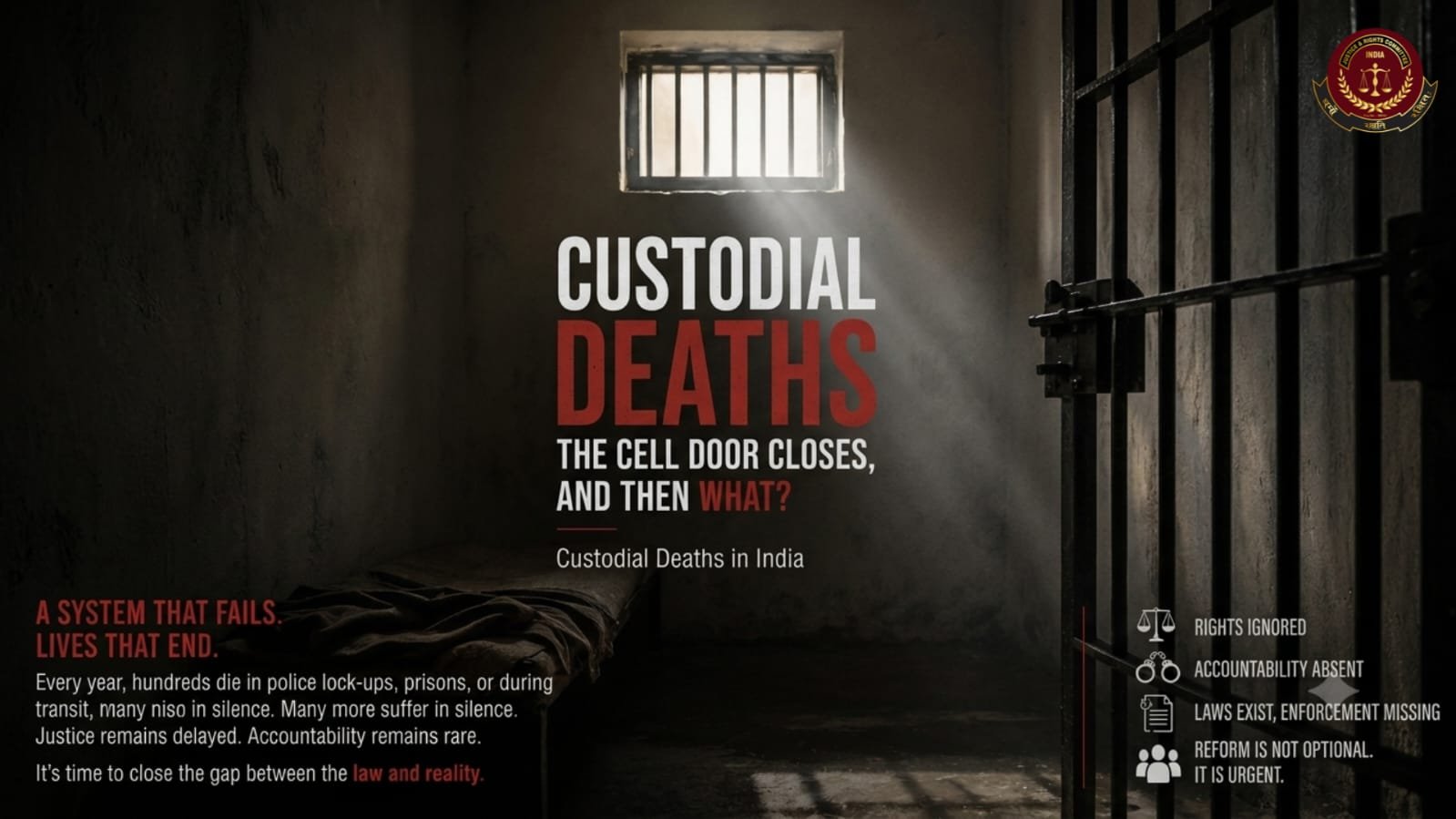
Every year, hundreds of people in India die while in the custody of the state- in a police lock-up, a prison cell, or during transit between the two. Some of these deaths are genuinely from illness or old age. Many others raise deeply uncomfortable questions about torture, negligence, and impunity. What makes the issue so persistent is not just the number of deaths, but how rarely anyone is held accountable for them.
What the Numbers Say
Custodial deaths in India are tracked through a patchwork of sources- the National Crime Records Bureau (NCRB), the National Human Rights Commission (NHRC), and government replies in Parliament- and the figures vary depending on which body is counting and what is included.
Government data placed in Parliament shows that recorded custodial deaths (a category that mostly captures deaths during police custody and immediate remand) have hovered betweenroughly 140 and 176 a year over the last five years, with 170 recorded in the 2025–26 financial year up to mid-March. Bihar and Rajasthan saw sharp increases in that period, with Bihar’s figures nearly doubling and Rajasthan’s doubling as well, while Odisha recorded the steepest percentage rise over a longer stretch of years. Maharashtra, by contrast, showed one of the largest declines.
These police-custody figures, however, are only part of the picture. When judicial custody- meaning deaths in jails and prisons, mostly of undertrial prisoners awaiting trial- is added in, the numbers climb dramatically.
Perhaps the most telling statistic isn’t the death toll itself, but what happens afterward: across the past five years of parliamentary data, only a single case resulted in disciplinary action against personnel- in Tamil Nadu. Older NCRB figures spanning 2000–2020 show a similarly stark pattern: nearly 1,900 custodial deaths but only 26 convictions, despite hundreds of cases being filed against police.
WhyDeaths Happen and Why They’re Hard to Prosecute
Custodial deaths are officially classified as “natural” or “unnatural,” but this line is blurrier than it sounds. A death from denied medical treatment, for instance, doesn’t fit neatly into either box, and researchers have pointed out that this ambiguity itself can mask negligence or abuse.
Several structural problems keep accountability rare:
- Investigations by the same institution. When police investigate deaths that happened in their own custody, even honest inquiries face an inherent conflict of interest, and there is a real risk of evidence being destroyed or records manipulated.
- No standalone anti-torture law. India signed the UN Convention Against Torture in 1997 but has never ratified it, and has no dedicated law criminalizing custodial torture.The Law Commission recommended such a law back in 2017; it still doesn’t exist.
- Chronic prison overcrowding. India’s prisons run at over 130% of their rated occupancy on average, a strain that worsens medical neglect and violence.
Legal Safeguards That Exist On Paper
India isn’t without legal protections against custodial abuse. The landmark 1996 Supreme Court judgment in D.K. Basu vs. State of West Bengal laid down eleven binding guidelines on arrest procedure and compensation for custodial deaths, later partly written into the Code of Criminal Procedure/now BNSS. Under NHRC guidelines, any custodial death must be reported to the NHRC within 24 hours, and a judicial magistrate, not a police officer, is required to conduct the inquest.
The problem, activists and legal scholars argue, has rarely been the absence of rules. It’s enforcement.
What Reform Would Actually Require
The reforms most commonly proposed by legal experts, parliamentary committees, and rights groups are not new ideas ,they’ve been on the table for years:
- A standalone anti-torture law that clearly defines custodial torture and mandates time-bound trials.
- Independent investigative oversight, giving the NHRC or a similar body real suo-motu powers rather than relying on the police to investigate themselves.
- Universal CCTV coverage in lock-ups and interrogation rooms, an idea the Supreme Court has already directed states to implement — with patchy compliance.
- Implementation of the Prakash Singh police reform guidelines, including fixed tenures and a separation of investigative and law-and-order functions, to reduce the pressures that often drive coercive interrogation.
- Fast-track courts specifically for custodial death cases, so that accountability doesn’t quietly die of old age alongside the case files.
Where This Leaves Us
Custodial deaths sit at an uncomfortable intersection of law, policing culture, and institutional self-protection. The legal architecture to prevent and punish them largely exists; what’s missing is the political and institutional will to use it consistently. Until investigations stop being conducted by the very institutions accused of wrongdoing, the gap between the number of deaths and the number of convictions is unlikely to

